The Felling of Lantern Waste and Enslavement of the Narnians
The Last BattleThe Felling of Lantern Waste and Enslavement of the Narnians is the extraction and forced-labor program imposed in Narnia under the false authority of Aslan. What begins as the cutting of an ancient forest becomes a system for moving Narnian resources and labor to Calormen, while Shift disguises coercion as paid work and public improvement. The episode makes environmental destruction and political deception part of the same assault on Narnian freedom.
Causes and Background
The felling first reaches the King as a plea from the living forest. A Dryad arrives mourning the destruction of her brothers and sisters and the holy trees, then asks for protection: forty great trunks have already been cut down in Lantern Waste. Her own tree is being felled miles away; she shudders as if struck and vanishes. The forest’s loss is thus not an abstraction or distant injury: its inhabitants experience each tree’s destruction as their own.
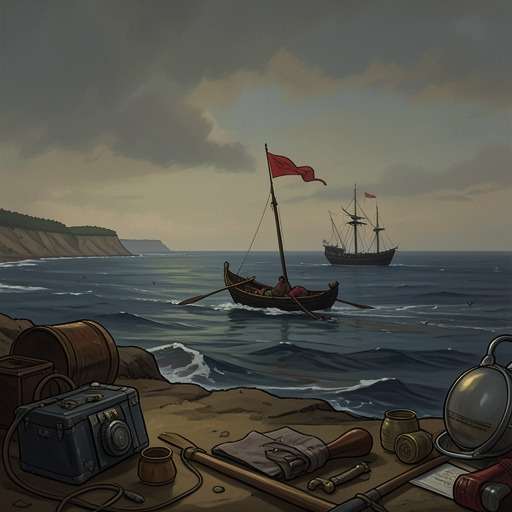
Tirian and Jewel then encounter the timber in transit. A raft of half a dozen newly cut trunks, stripped of branches and lashed together, moves swiftly down the river under the direction of a Water Rat. The Rat says the logs are being taken to sell to the Calormenes, and, when Tirian demands to know who authorized the felling, answers that it was Aslan’s order. That claim converts unauthorized extraction into supposed obedience to Narnia’s highest authority.
The scale and political character of the operation become visible when Tirian and Jewel reach Lantern Waste. A broad lane has been opened through the ancient forest, a muddy track where trees have been dragged to the river. The scene is marked by organized labor: people work among the felled timber, while horses strain at the logs under the direction of Calormenes. Narnia and Calormen are at peace, so the mere presence of merchants or ambassadors would not be inexplicable; the concentration of Calormene workers cutting down a Narnian forest is what exposes the deeper violation.
Extraction and Enslavement
The policy extends from timber to living labor. At first Tirian assumes the horses pulling the logs are ordinary, unreasoning animals. When one is struck, it protests that it is already doing all it can, revealing that the Calormenes have harnessed a free Talking Horse of Narnia. The discovery turns an apparently familiar labor scene into evidence that Narnian people are being compelled to work. Tirian and Jewel attack the two Calormenes who were driving the horse, a response that escalates the encounter into open conflict.
Shift announces that the labor will not end when the logs are delivered. He says every creature capable of work will be made to work: horses, bulls, and donkeys will be sent to Calormen for hauling and carrying, while moles, rabbits, and Dwarfs will be sent to the Tisroc’s mines. The scheme assigns different kinds of Narnian labor to the needs of the Calormene state, turning the forest operation into the opening stage of a broader program of removal and exploitation.
When the Beasts protest that Aslan would never sell them into slavery, Shift rejects the word rather than the substance of their fear. He claims they will receive good wages, but says their pay will go into Aslan’s treasury and be used for everyone’s good. A Calormene representative confirms that the Tisroc supports the plan. The arrangement leaves the workers under compulsion and the proceeds under the control of the authorities; calling the money wages does not give the laborers control over either their work or its return.
Deception and Coercive Rule
Shift presents the plan as a route to national prosperity. He promises that the money earned will make Narnia a country worth living in, with imported oranges and bananas, roads, and cities. In the same breath he lists offices, whips, muzzles, saddles, cages, kennels, and prisons. The juxtaposition shows the cost hidden inside the promise: the proposed modernization depends on making Narnian creatures governable, transportable, and punishable.
When an old Bear says that the Beasts want freedom and want to hear Aslan speak for himself, Shift asserts that he is a Man and dismisses the Bear as stupid. He redefines freedom as doing what he commands. The declaration exposes the program’s political logic: obedience is presented as liberty, while the demand for direct knowledge and independent judgment is treated as defiance.
The deception also suppresses the possibility of exposing itself. Tirian accuses Shift of lying and is about to challenge the claim that the bloodthirsty Tash could be the same as the good Lion who saved Narnia. Before he can continue, Calormenes silence and remove him. Shift orders him taken somewhere he cannot hear them and they cannot hear him, promising that justice will come later under the authority he claims to represent. The interruption keeps the central contradiction from being argued openly and turns supposed justice into a threat controlled by the conspirators.
Resistance and Consequences
The timber trade and labor policy propel the conflict beyond protest. After encountering the Calormenes exploiting the Talking Horse, Tirian and Jewel strike back; later, as resistance gathers, Rishda Tarkaan orders his force to seize its opponents and drive them into the Stable as an offering to Tash. The threat makes explicit how economic domination is backed by political violence: those who resist the extraction and its rulers are to be treated as captives and sacrifices.
The campaign against Lantern Waste consequently belongs to a larger struggle over who may speak for Aslan, who controls Narnian resources, and whether the Talking Beasts can remain free. Its environmental and social harms are joined: the forest is cut and carried away, and its inhabitants face displacement into labor for Calormen. The episode’s reversal of familiar promises—wages for imposed work, prosperity alongside cages, and freedom defined as obedience—shows how the false authority operates not only by force but by capturing the language used to explain force.